
On going to college, the apprentice system and the downside of DIY’ing a photography career
This afternoon I stopped by the camera shop. I needed a roll of seamless background paper, which I discovered on a shoot this morning when I reached the end of a roll, mercifully, just beyond the minimum amount necessary to get the shot.
As I approached the sales associate at the pro desk I warned him: don’t get excited, I’m not here to buy anything fun.
I’ve been going to this store for a long time. I’m old enough to remember when they got rid of darkroom supplies and then, eventually, brought them back again.
I’ve always checked in with Ray at the pro desk to get his take on the state of things. A camera retailer’s perspective is a good way to gauge changes to the photo business throughout the 2000s, from a sort of mysterious elitism 20 years ago to an egalitarian meritocracy today. (Buy a camera, learn it on YouTube, curate your grid and be up and running a photo business in no time.)
I asked Ray if business is booming. Alas, it is not.
The shop is simply not seeing as many pros, as many networking events, as many sales opportunities as it once did. The industry has, in many ways, decentralized, scattered to the wind. It’s moved from a real world analog endeavor to the ethereal production of images that live for mere moments online and we practitioners gear up via free shipping and coupon codes. Beyond the first stages of the digital and social revolutions, photography has pivoted from a standalone trade to a subset of the more commodified business of content creation. And that change reaches every corner of the business.
It’s a fully DIY world now, so why would any of us need to rely on the expertise of an individual in a camera shop? Like so many trends and traditions that once sustained the photography community, every standard seems now to have been replaced by a 21st century conventional wisdom. All of which can, apparently, be learned via YouTube and social media.
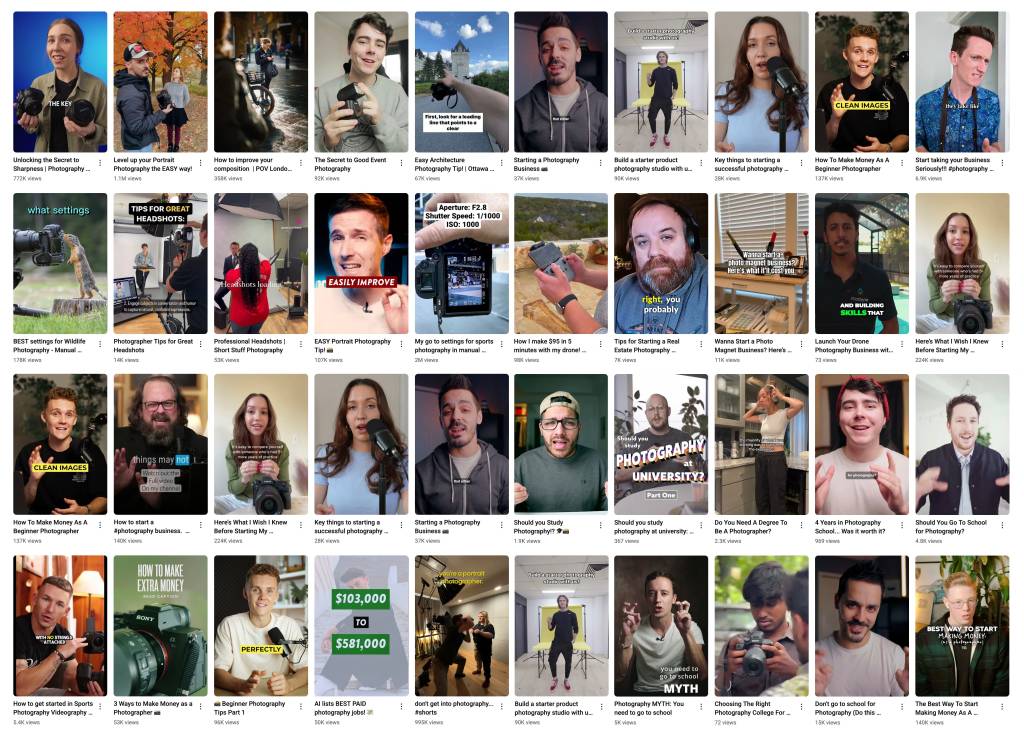
Once a week I stumble upon a discussion about whether a budding photographer should go to college. The consensus seems to be that it’s simply not worth it, which makes me sad.
I will agree it is not a good idea to go into crippling debt for a photography degree. But the idea that everything to be learned about the medium, the art, the philosophy, the business… All of that can be learned just as well on YouTube? I don’t buy it.
There’s plenty to learn online, absolutely. Enough, even, to build a thriving photography business. Acknowledging that truth, however, is not the same as saying there is no value in a college degree. You don’t need to go to college to learn photography, but you can learn an awful lot there, including critical thinking.
I mentioned to Ray my hesitation at suggesting a young person pursue a career in photography. (This was covered in a previous essay.) We agreed that it seems more challenging than ever.
With this, a young man nearby — 20-something, tall, stylish, patiently waiting — chimed in.
“That’s exactly what I’m trying to figure out,” he said.
We turned to him.
“I’m trying to decide if I should go to school to study photography,” the young man continued, “or just try to get a job and go do it.”
I told this young man that I had gone the college route and it was a very valuable experience and I learned a lot about photography. But in terms of doing the job of commercial photographer, the nuts and bolts of running a business, billing for my time… I learned more in the first year of working for another photographer than I learned in all that schooling.
If you want to learn to be an assignment photographer, I believe you should apprentice — go to work for, assist, intern, whatever — a photographer who does the type of work you want to do. Get your foot in the door and be with the people who are doing the job you want. You’ll learn photography, yes, but what you’ll really learn is how to be a professional, how to charge for your work, how to talk to clients, how to be creative while meeting that client’s needs, how to navigate a strange industry that’s getting stranger by the day.
With this in mind, I asked the young man what kind of work interests him. He showed me portraits on his phone and I could tell he was serious.
Yes, he explained, he was going to be a photographer, no matter who tried to talk him out of it. The only question was exactly what kind and exactly how he would get there.
I told him he’s got the right attitude: Don’t do it unless you absolutely must.
If there’s no question about what you want to do, that’s the ideal starting place. How you achieve your goals varies but as I told this young man, I think the apprenticeship approach is the best for learning our trade. If you can pair that with business and marketing skills learned in college, so much the better. Now you’re really positioned to make this career work.
I told the young man I would be glad to help him get started. We swapped numbers and I texted offering assistance. I also reached out to a friend saying I met someone who wants to do exactly what he does, and told my friend that, when the young man reaches out, I will connect them.
Which brings me to the ultimate question: will the young man reach out?
No, he won’t. Because he didn’t. All of this happened nearly a year ago.
I don’t get to ask Ray about the state of the photo business any more because he no longer works in it. Which could just be a coincidence, but with all the other evidence of a 2025 remapping of our industry I’m not quick to dismiss it.
Trends suggest this young man is not alone. We’re losing something vital if new photographers are no longer learning from experienced photographers doing the jobs they want to do. I believe it’s at least partially because, as a society, we’ve taken the DIY mindset a touch too far.
For the first 15 years of my career I was inundated with resumes and requests for internships — simple outreach saying hey, I want to be a photographer, can I work for you, or buy you a coffee and pick your brain? It was constant. They were getting in touch with me and my colleagues, desperate to learn by standing beside us, watching, helping, soaking it all in. It’s the way the photo business worked forever.
But not any more.
I rarely receive such solicitations these days, and I have a guess as to why.
It’s because they’re already in business for themselves.
Why not, right? It’s easier than ever to set up shop. More power to them. If the work is good and you can navigate the business, go for it.
But there are downsides to this. Most notably, the disappearance of institutional knowledge. Things photographers have taught assistants for generations are being lost in the void. Apprentices are now in business for themselves, learning from YouTube. It’s as if they’re all working for the same dozen online photographers, learning only what those few pass down. But what if those photographers don’t know everything about photography?
I recognize the tremendous positives in the disappearance of gatekeeping, that young people no longer feel the need to go to work for other photographers for low or no wages. You’ve got to hand it to Gen Z: they’ve had enough of our shit and they’re not gonna take it any more. They’re gonna do it the way that works for them, even if it’s not the exploitative way it’s always been done. Better, frankly, if it isn’t.
It’s true, they don’t need us. If the work is good enough, and if the socials are working, they’re gonna get jobs. Would they be better prepared after some time with a mentor? Sure, who wouldn’t. Along with the increase in competition from a supply side influx, one reason photography rates seem to be stagnant (or declining) is because the DIY approach doesn’t provide an opportunity to learn how established photographers actually charge. When you’re guessing, maybe $1,000 seems like a great rate for a given gig. But if you’d worked for an established photographer, perhaps you’d have learned that the decimal is in the wrong spot.
Just as a young lawyer working from home misses the benefits of hallway discussions that occur in an office, a young photographer figuring it out on their own is going to have to survive more mistakes in more rapid succession in order to stay afloat. It’s a tricky proposition.
The upside, of course, is the meritocracy. If the work is great, what’s the problem?
Photographers are my people. I want them to succeed. And it just seems like we are creating a path of least resistance that is not fully equipping the next generation for maximum success. Maybe it’s okay, because not everything can live forever. Maybe the plusses of content creation, of influencerdom and video production and all the other things that go into making money with a camera in 2025 and beyond… Maybe this is just what progress looks like?
Still, I hate to see all that specialized knowledge disappear. There’s a lot to be said for the old school approach of finding a photographer whose career you’d like to emulate and standing beside them while they do their thing. What an invaluable tradition. I hope it comes back into fashion.
I’m here, young photographers, if you’d care to reach out. I’ll be glad to set up a meeting. You bring the coffee, I’ll take a look at your portfolio. I’ll tell you about a bunch of mistakes I’ve made so hopefully you won’t have to. In the end, as it’s always been, maybe we can each learn something.
 Bill Sawalich • Photographer + Writer